The Lantern of Hatha Yoga
Obesience to Adinatha, the First Natha, who expounded the knowledge of Hatha Yoga, which, like a gleaming staircase, leads the aspirants to the high pinnacle of Raja Yoga.
Yogi Swatmarama, after saluting first his Guru, Srinatha, explains Hatha Yoga, solely for the attainment of Raja Yoga.
For those who are stumbling in the darkness arising from the multiplicity of false teachings, and so they are unable to know the Raja Yoga, compassionate Swatmarama composed the Lantern of Hatha Yoga, to dispel this very darkness.
Matsyendra, Goraksa, and other Masters possess the science of Hatha Yoga, and by their favour, Yogi Swatmarama also learnt it from them.
Homage to
Adinatha
Matsyendra
Sabara
Ananda Bhairava
Chaurangi
Mína
Goraksha
Virupaksa
Bilesaya
Manthana
Yogi Bhairava
Siddhi
Buddha
Kanthadi
Korantaka
Surananda
Siddhipada
Charapati
Kaneri
Pujyapada
Nityanatha
Niranjana
Kapali
Bindunatha
Kakachandishwara
Allama
Prabhudeva
Ghoda
Choli
Tintini
Bhanuki
Nardeva
Khanda
and Kapalika
These mighty siddhas, with the power of Hatha Yoga, broke the Sceptre of Death, and roaming the Universe to this very day.
Hatha is shelter for all who suffer.
For every committed practitioner, Hatha Yoga is like Akupara, the World-bearing Tortoise, carrying all on its back.
Those who seek fulfillment, should keep the knowledge of Hatha Yoga in great secret, for it is potent if concealed, but becomes impotent if exposed.
The Hatha practitioner shall live alone, in a small hut. There shall be no rocks, fire or water around in a 2-metre circle.
Well governed, law-abiding land it shall be where food can be obtained easily and will not be in peril.
The Hatha practicing Siddhas described the ideal habitat of a Yogi as it follows:
It has a little door with no holes, gaps or hollows.
Neither too high, nor too low or long.
Plastered well with cowdung, free from worms and vermin, immaculate.
A shrine, an altar and a well next to it. Fences all around.
Live in a hut like this, free from all troubles.
Practice Yoga only, according to the Master's teaching.
Too much food, exertion, chatter, keeping unnecessary rules, human company and inconstancy. These 6 things ruin Yoga.
Perseverance, tenacity, firmness, true knowledge, firm conviction and avoiding human company.
These 6 things fulfill Yoga
Here are the major and minor rules:
Non-harm, truthfulness, non-stealing, self-restraint, patience, determination, compassion, honesty, moderation in eating, and cleanliness: these are the ten main precepts.
Penance, contentment, faith, giving, reverence for God, listening to yogic doctrines, modesty, devotion, recitation of mantras and offering sacrifices: these are the ten minor rules, as taught by those well-versed in the textbooks of Yoga.
Here is Asana:
Since Asana is the first part of Hatha, I will explain it first. Asana makes us strong, healthy, and our limbs become light.
I will explain a few Asanas which were recognized by Vasistha and other sages, and by Matsyendra and other yogis.
Place your feet crosswise in the crook of your knees.
Sit up straight: this is called the Swastika Asana.

Place your left ankle behind your right side,
and your right ankle behind your left side:
this is called Gomukha (Cow Head) Asana
because it resembles the head of a cow.

Press one foot to the other thigh, that thigh rest on the leg:
this is the Vīra (Hero) Asana

Cross your ankles, covering your anal outlet:
this is known to yoga practitioners as Kurma (Tortoise) Asana

Positioned in Padma (Lotus) Asana,
put your hands in the bend of your knees, then,
leaning on them, pressing the ground, rise up:
this is the Kukkuta (Rooster) Asana.

In Kukkuta-asana, with your hands clasped behind your neck,
lie on your back like a tortoise:
this is the Uttana-Kurma (Recumbent Tortoise) Asana.


Hold both big toes
and pull them towards your ears,
as if you were stringing a bow:
this is called Dhanur (Bow) Asana.
Place your right foot under your left thigh, then, grasping the left foot placed outside your right knee, turn your torso:
This Asana was taught by the venerable Matsyendranatha
The Matsyendra position increases the stomach fire,
and is an effective antidote for many serious diseases.
Its practice awakens the Kundalini
And fixes the Chandra

With your legs extended on the ground like sticks, grasp the tops of your feet and touch your knees with your forehead: this is called Paschima-Uttana (Rear Stretch) Asana.
Paschima-Uttana, the most excellent Asana,
carries the air to the Sushumna.
It increases the stomach fire,
slims the abdomen,
and makes a person healthy.

Rest your hands on the ground, with your elbows at the navel.
Rise up straight: this position is called the Mayura (Peacock) Asana.
The noble Mayura Asana quickly removes all diseases
of the spleen, stomach and other organs,
and eliminates disorders of the bodily fluids.
It helps the digestion of those who have eaten much bad food,
increases the stomach fire, and also destroys deadly poison.

Lie on your back on the ground like a dead person: this is the Sava (Corpse) Asana. The Sava Asana removes fatigue and rests the mind.

Shiva taught eighty-four Asanas. I will tell you the four most fundamental ones:
Siddha (Perfect)
Padma (Lotus)
Sinha (Lion)
Bhadra (Blessed)
These are the four.

Of these, the most pleasant Siddha Asana is the one you can always spend time in. Place left heel to the perineum and the other on the genitals.
Press your chin firmly on your chest.
Motionless, with your senses restrained,
look with unwavering gaze between your eyebrows:
this is called the Siddha Asana that opens the door to liberation.
However, according to others, the left ankle should be placed near
the genitals, and the other on top of it - this is Siddha Asana.

This is called Siddha Asana,
although some know it as Vajra (Diamond) Asana.
Some call it Mukta (Liberated) Asana,
others call it Gupta (Secret) Asana. Just as moderation in eating is among the major precepts, and non-harm is among the minor precepts, Siddha Asana is considered by Masters to be the greatest of all Asanas.
Of the eighty-four postures, one may constantly practice only the Siddha. This purifies the seventy-two thousand Nadis.
If a yogi turns inward, eats moderately, and practices the Siddha Asana for twelve years,
he always attains perfection.
What is the need for many other postures, if by sitting in perfect Siddha Asana, concentrating on the prana-air and performing Kevala-Kumbhaka, the state of Unmani Kala easily and spontaneously arises?
Furthermore, if the Siddha Asana alone is perfectly firm, then even the three Locks easily, on their own accord, will happen.
There is no Asana comparable to the Siddha!
No Kumbhaka superior to the Kevala!
No Mudra equal to the Khechari!
No Laya comparable to the Nada!
Here is the Padma Asana:
Place your right foot on your left thigh, and your left foot on your right thigh. Hold your two big toes tightly with your hands behind your back. Press your chin to your chest and fix your gaze on the tip of your nose: this is called the Padma Asana, which conquers the diseases of the practitioner.

Place your two feet carefully on your thighs, soles facing upwards, and rest your hands on your thighs, palms facing upwards. Direct your gaze towards the tip of your nose. Place your tongue at the base of your upper teeth and, keeping your chin pressed to your chest, slowly direct the air upwards.

It is believed that the Padma Asana destroys all diseases. Although it is very difficult to perform, the wise can master it in this world. Sitting in a very firm Padma Asana with folded hands, the chin firmly pressed to the chest, concentrating on God in the mind, constantly letting the Apana air rise, and pushing the inhaled air down simultaneously through Shakti, one attains unparalleled awakening. The yogi sitting in the Padma Asana, who retains the air inhaled through the nadis, is undoubtedly liberated.

Here is the Sinha Asana:
Place your ankles under the scrotum, on each side of the perineum: the left ankle on the right, the right ankle on the left side. Place both hands on your knees with fingers spread. With your mouth wide open, look with great concentration at the tip of your nose. This is the Sinha Asana, which is praised by the greatest yogis. This is the most excellent Asana that unites the three Locks.

Here is the Bhadra Asana:
Place your ankles under the scrotum, on both sides of the perineum: the left ankle on the left, the right ankle on the right side. With your legs tightly clasped by both hands, remain completely motionless: this is the Bhadra Asana, the destroyer of all diseases. The perfect yogis call it the Goraksha Asana.
An excellent Yogi, tireless in the practice of Asanas and Bandhas, should perform Mudras and other purifying practices to clean the Nadis.
Asanas, various Kumbhakas, Mudra exercises, then concentration on the Inner Voice: this is the order of practice in Hatha Yoga.
Who lives a life of self-restraint, eats moderately, is renunciative and devoted to Yoga, will attain perfection in a year, no doubt.
It is called moderate eating when one-fourth of the very soft and sweet food is reserved and offered to Siva.
Bitter, sour, pungent, salty, hot, greens, astringent porridge, oily, sesame and mustard seeds, alcohol, fish, goat and other meats, curdled milk, buttermilk, chickpeas, jujube fruit, fried cakes, the asafoetida and garlic are not considered proper food.
Do not eat food that is reheated, acrid, too salty, vinegary, spoiled or prepared with too many vegetables. In the beginning, avoid fire, women and travel.
Similarly, Goraksha's advice is:
Keep away from bad people, fire, women, refrain from traveling, bathing at dawn, fasting, and other bodily austerities.
Wheat, rice, barley, sixty-day-old rice, excellent grains, milk, ghee, sugar, fresh butter, refined sugar, honey, dried ginger, patola (sponge gourd/silk squash) and the other four vegetables, beans and celestial water: these are the proper foods for the excellent yogi.
The yogi shall eat according to his taste:
-nutritious, sweet, oily, foods
-foods containing dairy products
-appropriate foods nourishing the bodily fluids.
Whether young, old or elderly, sick or weak, if one practices yoga tirelessly, one will attain perfection.
He who practices with determination will attain results.
How can one who does not practice achieve results?
Yoga cannot be attained by merely reading textbooks.
Stories of accomplishments are not the cause of accomplishments themselves,
nor is wearing the robe!
Only practice leads to success, this is the truth, no doubt.
Among the practices of Hatha Yoga, all the postures, the various Kumbhakas and other sublime actions, are used only until the fruit of Raja Yoga is attained.
Thus says the first teaching in the Lantern of Hatha Yoga...
When the Yogi, who has mastered the Asanas, self-controlled and eats proper and moderate food, can start Pranayama exercises, as taught by the Master.
If the breath moves, the mind moves
if it is still, the mind becomes still.
In order to become firm, the yogi should bring the breath under his control. As long as the breath is in the body, it is called life. Death is the departure of the breath, so let the breath be brought under his control. If the Nadis are filled with impurities, the air cannot move in the middle. How is the state of Unmani possible? How can success be achieved?

Once the entire circuit of the Nadis filled with impurities is cleared, only then will the Yogi be able to control the breath fully. Therefore, the Yogi should regularly perform Pranayama with a Sattvic mind, so that the impurities in the Sushumna Nadi are purified.
The Yogi sitting in the Padma Asana, shall inhale through the left nostril.
Hold the breath as long as you can,
then exhale through the right nostril.
Inhaling the air through the right nostril,
slowly fill the abdomen.
Then do Kumbhaka properly,
and exhale through the left nostril.
The nostril you exhaled from, you are going to breathe in now and hold the air in with all your strength,
Then exhale through the other nostril very slowly, not violently!
If you inhale through the left nostril (Ida), hold it, then exhale through the other.
Then inhale through the right nostril (Pingala), hold it, then exhale through the left.
This way, in three months, the austere practitioner's all Nadis will be purified,
if they practice regularly through the right and left nostrils.
Do Kumbhakas in the morning, at noon, in the evening and at midnight,
until you gradually reach four times eighty a day.
At the beginning you start to sweat,
at the middle you start to tremble,
and at the end you become firm.
When that happens, fix your breath. Rub your body with the sweat produced by the exertion. That will make the body strong and fresh.
In the initial stages of practice, a diet consisting of milk and clarified butter is recommended. Later, when you have become confident in your practice, you need not adhere to such rules.
Just as the lion, the elephant, and the tiger can only be tamed slowly, the breath must be handled in the same way,
otherwise it will destroy the practitioner.
By the correct practice of Pranayama, all diseases disappear,
by incorrect practice, all kinds of diseases arise.
Hiccups, asthma, cough, headache, earache, and eyeache, and various other diseases arise due to the disturbance of breathing.
Exhale the air in the prescribed manner, inhale it correctly, and retain it properly.
This way you will achieve success.
When the Nadis are purified, there will be external signs: the body becomes slim and visibly beautiful. When the Nadis are purified, the breath can be held at will, the digestive fire flares up, the inner voice appears, and the yogi becomes healthy.
He who has excess fat and secretions, should first perform the six purifying exercises. However, he who has the bodily fluids in balance, should not perform them!
Dhauti (Purification), Basti (Enema), and Neti (Thread insertion), Trataka (Gazing), and Naulika (Internal abdominal massage) and Kapalabhati (Skull shining).
These are called the six purifying practices. These six practices, which purify the body, are to be kept secret. They produce many wonderful powers and are highly revered by the most excellent Yogis.
Here is the Dhauti:
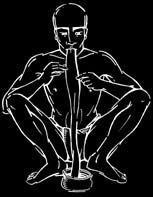
Swallow a moistened cloth, four fingers wide and 7 metres long, in the manner shown by the master, and then retract it. This is called the Dhauti practice.
Cough, asthma, spleen diseases, leprosy and twenty kinds of mucous diseases will undoubtedly disappear by the Dhauti practice.
Here is the Basti:
Having inserted a tube into the anus, in navel deep water, the yogi sitting in Utkata Asana, perform suction by rectal contraction. This cleansing with (warm)water is the practice of Basti.

By the practice of Basti, the enlargement of the pancreas, spleen, abdominal disease, and all diseases arising from wind, bile, and phlegm are eliminated.
Basti with water calms the bodily fluids, the senses, and the mind.
It increases appetite and makes you beautiful.
It completely destroys all bodily fluid diseases.
Here is the Neti:
A thread about 23 centimetres long, thoroughly anointed with oil or beeswax , should be inserted through the nostril and pulled out through the mouth. This is called the Neti by the Siddhas.

It purifies the skull and grants clairvoyance. Neti quickly eliminates many diseases that arise above the collarbone.
Here is the Trataka:
Concentrate at a point with unwavering gaze until your eyes filled with tears. The teachers call this Trataka.
Trataka liberates you from eye diseases, is a barrier to enervation and other troubles.
It should be carefully kept secret, like a little treasure box.

Here is the Nauli:
With the shoulders bent and leaned forward, the Yogi makes rapid turns of the abdomen, vigorously moving it right and left. The Siddhas call this Nauli.
Remedies weak digestion. It is curative, always brings happiness and dries up all diseases of bodily fluids. This is Nauli, the crown of Hatha exercises.


Here is Kapalabhati:
If the exhalation and inhalation are fierce, like a blacksmith's bellows, it is called Kapalabhati.
It dries up the excess mucus.
After you have purified yourself of excess fat, mucus, secretions coming from bodily fluid disorders, and other troubles through the six cleansing practices, perform Pranayama.
You will easily achieve success.
Pranayama practices alone dry up all defilements, as some teachers say, and so they do not recommend other cleansing practices.
Here is Gajākarānī (Elephant exercise):
By moving the Apāna Air upwards, the Yogi vomits the matter that has entered the stomach. The yogi brings the circle of Nadis gradually under his control as he observes.
Those who know the Hatha, call this Gajākarānī.
Even the thirty gods, Brahma and the others, practiced breathing exercises in fear of death. Therefore the Yogi should also focus his attention on the breath. As long as the breath is retained in the body, as long as the mind is not disturbed, as long as the gaze is fixed between the two eyebrows, why should one fear death?
When the circuit of the Nadis is purified by proper breath control, the air, penetrating through the entrance of the Sushumna, enters it with ease.
Here is the Manonmani (Consciousness without consciousness):
When the air passes through the central channel, a fixed state of mind is created.
A very firmly fixed state of mind is Manonmani. To achieve this, those who know the proper methods shall perform various Kumbhakas. By performing various Kumbhakas, the Yogi achieves wonderful success.
Here are the types of Kumbhakas:
Suryabhedana (the Impaling of the Sun)
Ujjayi (Victorious)
Sitkari (Hissing)
Sitali (Chilling)
and
Bhastrika (Bellowing)
Bhramari (Buzzing)
Murchasha (Vertiginous)
Plavini (Floating)
These are the eight Kumbhakas.
At the end of the inhalation, perform the Jalandhara Bandha (Throat Lock). At the end of the Kumbhaka, at the beginning of the exhalation, perform the Uddiyana Bandha (Diaphragm Lock) By rapidly contracting the rectum, throat and abdomen, together, the air goes into the Brahma Nadi.
Raise the Apana and guide the air down the throat.
This way, the Yogi is freed from old age, as if he was sixteen years old.
Here is the Suryabhedana:
The yogi should take a comfortable sitting position and, while performing the Asana, slowly inhale the air through the Right Nadi.
Hold it until it has passed from the hair to the tips of the nails ("from head to toe").
Then very slowly exhale the air through the Left Nadi.
Skull-cleanser, destroys disorders arising from the wind of the body, removes worms.
Repeat the excellent Suryabhada again and again.
Here is Ujjayi:
With the mouth closed, slowly inhale the air through the two Nadis, so that it can be heard and felt from the throat to the chest.
Retain the air in the former manner, then exhale through the left nostril.
It removes the plaque in the throat and increases the fire of the body.
It eliminates dropsy, fistula and disorders of the bodily fluids. The Yogi can practice the Kumbhaka, which is called Ujjayi, both standing and walking.
Here is the Sitkari:
Inhale the air with a hissing sound through the mouth, opening it a little, and exhale it through the nose.
By practicing in this way, you will become the mirror image of Kamadeva (God of Love).
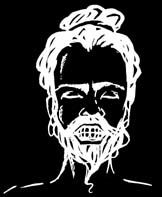
Sitkari is revered amongst Yoginis (female Yogis), Sitkari performs creation and the retraction of creation. You will neither be hungry nor thirsty, you will not be sleepy, and you will never become weak.
The real essence of your body will become free from all disturbances.
This way, one will truly become the most excellent Yogi of the World.
Here is the Sitali:
The wise Yogi shall inhale the air through his tongue and, like with the previous ones, perform Kumbakha, then exhale slowly through both nostrils.

Sitali destroys problems arising from diseases of the pancreas and spleen, removes fever, gallstones, hunger, thirst, and poisons.
Here is the Bhastrika:
If both the feet are placed on the two thighs – this is Padma Asana. This eliminates all sins.
Aprropiately positioned in Padma Asana, keeping the neck and the abdomen in the same line, the Wise, with his mouth closed, should exhale forcefully through the nose!
Strong so that it may be heard and felt from the chest and throat to the skull,
then fill with air absolutely so it reaches the very Heart Lotus.
As before, breathe out again and in again and repeat over and over, just as the Master Blacksmith operates his bellows, with power.
In the same way, move the air in your body mentally.
If a feeling of fatigue arises, inhale through the right nostril.
Once the abdomen fills with air, gently close the nose tightly, without using the index and middle fingers.
If you have performed Kumbhaka properly, exhale through the left nostril. Removes wind, bile and phlegm, increases the body's fire.
Bhastrika quickly awakens the Kundalini, cleanses and grants happiness, so is beneficial.
It destroys the mucus and other obstructions at the entrance of the Brahma Nadi.
This Kumbhaka called Bhastrika, which pierces the three knots (Brahma, Visnu, Rudra in the chest, in the throat and between the eyebrows) in the body,
should especially be performed in a proper manner!
Here is the Bhramari:
The inhalation is strong, with a male throbbing sound, the exhalation is very slow, with a female throbbing sound. When practiced in this way, a kind of blissful state arises in the mind of the excellent Yogis.
Here is the Murchasha:
At the end of the inhalation, make a tight Jalandhara Bandha and slowly exhale.
The blissful stupor of the mind during this act is the Murchasha.
Here is the Plavinī:
If the Yogi's belly is filled with the noble breath that has spread within, even in deep water he will easily float like a lotus leaf.
Pranayama is said to be threefold:
exhalation, inhalation, and Kumbakha.
Kumbhaka is considered to be twofold: Sahita and Kevala.
One practices Sahita until one succeeds in Kevala, which is nothing but the easy retention of breath by omitting exhalation and inhalation.
Then Kevala Kumbhaka is called Pranayama when it is successfully performed without exhalation or inhalation.
There is nothing difficult to attain in the three worlds (underworld, earthly, other-worldy) for one who is able to retain the breath at will with Kevala Kumbhaka.
The Yogi will undoubtedly reach the stage of Raja Yoga.
By Kumbhaka, the Kundalini is awakened. By the awakening of Kundalini, the Sushumna is freed, and Hatha Yoga is successful.
Without Hatha, Raja Yoga is not possible, and without Raja Yoga, Hatha is not successful, therefore practice both until the final result.
After completing Kumbhaka breath retention, make your mind empty. By practicing in this way, you will advance towards the stage of Raja Yoga.
A beautiful figure, slimness, a radiant face, the appearance of the Inner Voice, very clear, bright eyes, health, control over the male seed, the ignition of the consuming fire and the purification of the Nadis characterize the success achieved in Hatha Yoga.
Thus says the second teaching in the Lantern of Hatha Yoga...
Just as the ground covered with rocks and forests is founded by the King of Serpents,
so is the foundation of all Yoga Tantras by the Kundalini serpent. After the sleeping Kundalini is awakened by the grace of the Master, it pierces all the Lotuses (Chakras) and knots. Then the Path of Emptiness (Susumna) becomes the Royal Path of Breath, the mind is not attached to anything, and even passing away can be evaded. Susumna (Most Auspicious), Sunyapadavi (Path of Emptiness), Brahmarandhra (Brahma-cavity), Mahāpatha (The Great Path), Smasana (Funeral Pyre), Sambhavi (Belonging to Shiva), and Madhyamarga (Middle Path): these are synonyms.
Therefore, let us perform Mudra exercises with all our strength, to awaken the Sleeping Goddess (Kundalini) at the entrance of the Brahma-cavity. Here is the division of Mudras: Mahamudra (Great Mudra)
Mahabandha (Great Lock)
Mahavedha (Great Piercing)
Khechari (Sky-striding)
Uddiyana (Rising)
Mulabandha (Rectal Lock)
Jalandharabandha (Throat Lock or Water-holding Lock)
Viparitakarani (Reverse Exercise)
Vajroli (Sexual energy exploit and sexual fluid retention)
Saktichalana (Force-movement)
These are the ten mudras. They stop old age and abolish death.
Adinatha revealed the sacred Mudras which bring about the eight supernatural powers.
They are dear to all the Siddhas, and even the Wind Gods have great difficulty in accessing them. They must be carefully kept hidden, like a casket full of precious stones. No one should reveal them, just as we do not speak of the love life of a noble lady.
Here is the Mahamudra:
Pressing the left heel against the perineum, extend the right leg, and hold it firmly with both hands. Forming a lock in the throat, hold back the air from above. Just as a snake struck with a stick becomes stick-shaped, so the Kundalini force also straightens up suddenly. Then the Kundalini residing in the double cavity enters a death-like state. Exhale the air very slowly, by no means vigorously! Thus the great Siddhas have taught the Mahamudra.
Great pains, diseases and death all disappear. That is why the greatest sages call this Mudra Mahamudra.
After practicing on the left side, practice on the right side. Stop when you have practiced on both sides an equal number of times. There is no such thing as wholesome or unwholesome, palatable or tasteless. Deadly poison and nectar are both taken in by the stomach. || 16 || Lung disease, leprosy, constipation, spleen disease, indigestion and other diseases will disappear if you practice the Mahamudra. The Mahamudra mentioned above gives a person great supernatural abilities. It should be carefully kept hidden and should not be revealed to anyone.
Here is the Mahabandha:
Place the heel of the left foot on the perineum, and the right foot on the left thigh.
Breathe in, press your chin to your chest, and hold your breath, concentrating on the center. Retain the breath as long as you can, and then slowly let it out. If you have practiced on the left side, practice on the right side too. In this regard, some people are of the opinion that we should avoid the throat lock, a tongue lock placed on the front teeth is sufficient.
This blocks the upward movement in all the Nadis. Mahabandha certainly gives great supernatural powers. The Yogi, skilled in liberation from the net of death through Mahabhandha, brings about the union of the threefold confluence (Gangaa, Jamunaa, Saraswathi= Ida, Pingala, Susumna) and brings his mind to the Kedar (A Holy Summit in the Himalayas, residence of Shiva = Ajna, between the eyebrows).
Just as a beautiful and charming woman is without a man, so Mahamudra and Mahabhandha are fruitless without the Wisdom.
Here is the Mahavedha:
The Yogi sitting in Mahabandha should breathe in with concentration and stop the movement of the body-airs firmly, by means of the throat Mudra. Place both hands on the ground, gently hit the bottom on the ground. The air leaves the two cavities and bursts in the middle.
The Moon, the Sun and the Fire are connected so that immortality comes. The state of the dead is established (Kundalini straightens) Then the air is released.
If we practice Mahavedha in this way, we gain wonderful abilities. The greatest practitioners respect it as the one that eliminates wrinkles, gray hair, and tremors. These are the three great secrets that conquer old age and death. They increase digestive fire dramatically.
They result in shrinking to the atomic scale and other abilities.
Practice them eight times every day, every three hours.
They accumulate a multitude of merits, and destroy heaps of sins. Those who have received proper instruction, practice moderately at first!
Here is the Khechari:
In the oral cavity, the tongue is bent back. The gaze is between the two eyebrows. This is the Khechari mudra.
By cutting, moving and pulling, gradually extend the tongue until it reaches the part between the two eyebrows. Only then will the Khechari be successful. Therefore, with a sharp, smooth, clean instrument like a leaf of Euphorbia antiquorum, make a small cut a string of hair. Then rub it with crushed sea salt and Terminalia citrina. After a week, make another cut like a string of hair.
Do this for six months, gradually, with constant attention. After six months, the ligament at the base of the tongue (the frenulum) will disappear completely.
Bend the tongue back and align it with the three paths (esophagus, trachea and uvula).
This is the Khechari Mudra. It is called the Celestial Circle (Vjyoma Chakra). If the Yogi bends his tongue upwards even for a moment and remains so, he will survive poisoning, be freed from diseases, death, and old age.
He who knows the Khechari Mudra will not get sick, will not die, will not get tired, will not fall asleep, will never be hungry, will never be thirsty, will never faint.
He who knows the Khechari Mudra will not be tormented by disease, will not be defiled by deeds, will not be tormented by death.
The mind travels in the Sky (Khe), while the tongue moves in the cavity (Khe). That is why the Siddhas have created this Mudra called Khechari.
He who closes the cavity above the tongue with Khechari, his seed will not flow, even if a beautiful woman embraces him.
A Master of Yoga, who drinks Soma firmly with his tongue raised, will undoubtedly conquer death in two weeks. If the Yogi's body is constantly saturated with Soma drops, even Taksaka, the Serpent King can bite him, his poison will be ineffective.
The embodied soul does not leave the body if it is saturated with Soma-drops,
just as fire never leaves the firebox,
a lamp never leaves the oil and wick.
Always eat beef! Drink nectar wine! Whoever does this, I consider to be excellent, everyone else is a disgrace to the family. By the word “beef” we have referred to the tongue. The pressing of the tongue against the palate is the “eating beef”, which nullifies serious sins. The moisture flowing from the Moon, which is produced by the fire that is ignited when the tongue is pressed there: this is “nectar wine”. If the moist tongue, while tasting pungent, bitter, sour, and tastes like milk, honey, and ghee, repeatedly touches the tip of the uvula, diseases disappear, old age ceases, the weapon that strikes the Yogi is deflected, immortality and the eight wonderful powers come, and the Yogi can seduce any charming woman. If the Yogi thinks of the supreme power, drinks the undulating, clear, flowing Moondrops that drip from the crown of his head onto the
Sixteen-petalled Lotus, which the breath has reached, and presses his tongue tightly back into the cavity, he remains healthy, acquires a body as delicate as a lotus, and will live long.
From the hollow at the summit of Meru (Holy Mountain of Gods = spinal column) flows the melting snow.
According to the sages, truth is there. This is the source of rivers. From the Moon, the essence flows away, and therefore the human body perishes. This is prevented by this excellent method. Otherwise, the effort will not be successful. The five rivers flowing from the hollow, brings forth wisdom. In that spotless emptiness, the Khechari resides.
The seed of creation is one.
There is one mudra: the Khechchari.
There is only one God, the Supreme.
There is one state: the Manonmani.
Here is the Uddijānabandha:
The Yogis called this exercise Uddijāna (Rising) because with its help the stopped breath rises in the Sushumna. Like a great bird, the air rises tirelessly through Uddijāna. The description of the Bandha is as follows:
The abdomen is drawn in, namely above the navel. Uddijānabandha is the Lion conquering the Elephant of Death. Uddijāna is very easy if it is performed under the supervision of a Master. Whoever practices it constantly, even if old, becomes younger.
The abdomen is drawn in strongly below and above the navel. After six months of practice, death is conquered, no doubt.
Of all the Bandhas, Uddiyāna is the best. If you practice Uddiyāna firmly,
liberation will come by itself.
Here is the Mulabandha:
Pressing the heel against the perineum, squeeze the anus. Draw the Apana-air upwards. This is the Mulabandha. The Yogis call it Mulabandha (Lower bandha) because by squeezing, they direct the lower current, or Apana, upwards with great force. Pressing the heel against the anus, hold back the air strongly, again and again, so that it can rise. When the Prana- and Apana-air, the Nada (female genital fluids) and the male seed, unite through Mulabandha, they bring success in Yoga, no doubt.
The unity of Apana and Prana results in a decrease in urine and stool. Even if the Yogi is old, he becomes younger if he regularly practices Mulabandha. When the Apana starts going upwards and reaches the circle of fire (Manipura Chakra), the flame, as the air strikes it, becomes longer. Then the fire and the Apana reach the naturally hot Prana. This drastically increases the fire in the body. This scorches the sleeping Kundalini, which awakens. Like a snake struck with a stick, it straightens up, hissing. As if it were hiding in its snake-hole, it crawls into the Brahma-nadi. That is why Yogis should always and regularly perform Mulabandha.
Here is the Jalandhara Bandha:
With the throat contracted, place your chin on the chest. This is the Jalandhara Bandha.
It abolishes old age and death.
It closes the bundle of Nadis and the downward flowing celestial water.
Therefore, it is Jalandhara (Water-container [cloud]) Bandha. It cures all kinds of throat ailments.
If Jalandhara Bandha is performed, which is characterized by the constriction of the throat, then no nectar will fall into the fire and the breath will also calms down.
By constricting the throat, the two Nadis should be tightly closed. This is known as the middle circle (Madhyachakra) and it closes the sixteen Adharas.
With the lower body contracted, perform Uddiyana. With the Ida and Pingala closed, direct the air upwards through the back channel.
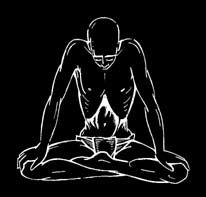
By this method the air becomes calm, and death does not occur, there is no old age, no disease.
These three Bandhas are the best, all the great Siddhas also practice them. These are the well-known exercises of all Hatha-Tantra Yogis.
Whatever nectar drips from the divine Moon, the Sun absorbs it to the last drop.
This is why the body ages.
There is an excellent method that prevents the Sun from doing this.
It must be learned through the teachings of a Master, and not by studying thousands of textbooks.
Here is the Viparitakarani:
Since the navel is above and the palate below, therefore the Sun is above and the Moon below.
The practice called Viparita (reverse) can be understood from the teachings of the master.
The regular practitioner increases the fire in the stomach.
Have plenty of food at his disposal. If he eats little, the fire will burn him in an instant.
The head is below and the feet are above: the first day only for a moment.
Every day one shall practice it a little longer.

After only six months, wrinkles and gray hairs will disappear.
If you practice just three hours every day, you will overcome death, no doubt.
Here is the Vajroli:
Even if the Yogi lives according to his whims and fancies, and ignores the minor rules imposed by Yoga, the Yogi who knows Vajroli can count on success.
Two things are required for this, both are very difficult for everyone to obtain.
First is Nectar
The other is adutiful woman.
Practice pulling (Muscle contraction) the penis up slowly and properly.
Both men and women can be successful in the Vajroli. |
Blow slowly and firmly into the urethra with a suitable tube so that air can enter.
With practice, you can suck back semen that has fallen into the vagina.
After sucking back semen, retain it.
He who is skilled in Yoga and thus preserves his seed, conquers death.
The loss of the seed is death, its preservation is life.
By preserving the seed, a pleasant fragrance is produced in the Yogi's body.
While the seed is firmly in the body, why should we fear its disappearance?
A man's seed depends on his mind, and his life on his seed. Therefore, the seed and the mind must be protected with all might.
Here is the Sahajoli:
Sahajoli and Amaroli are actually two types of Vajroli.
Sprinkle the ashes of burnt cow dung into water.
The anointing of the body of a man and a woman, sitting comfortably and resting, immediately after Vajroli intercourse, this is the Sahajoli. Yogis can have absolute confidence in it.
This wholesome Yoga, although it is attached to pleasure, results in liberation.
This Yoga can be achieved by people who have acquired merit, are strong, see the truth, and are free from envy, but for the twisted and envious it's not possible.
Here is the Amaroli:
The first stream of water is omitted because of the excess of bile and the last stream because of its thinness, and the middle, cool stream is used as Amaroli in the Khanda type Kapalika community (Shaiva Sect who beg for donations with an empty skull)
He who constantly drinks and sniffs Amaroli every day, is practicing Vajroli correctly
The semen that has flowed out during the practice should be mixed with cow dung ashes, and applied to the upper parts of the body. Divine vision is thus born.
If a woman, through proper practice, skillfully collects the semen of a man, and with the help of Vajroli, she can be called a Yogini. Not a single drop of menstrual blood she will lose, no doubt. In her body the Nada (Universal Pulse of Life)becomes like a seed.
The seed and the blood, becoming one in the human body, by the Yoga of the Vajroli practice gives all wonderful abilities. If a woman retains the blood after the withdrawal, she can be called a Yogini. She knows the past, the future, walks unshakably in the sky, and her body attains its supernatural perfection by the Yoga of the Vajroli practice. This purifying Yoga brings liberation even in the midst of pleasures.
Here is the Sakti Chalana:
Kutilangi (swaying bodied), Kundalini (ring), Bhujangi (serpent), Shakti (power), Isvari (goddess), Kundali (ring) and Arundhati (trendil): these words are synonymous.
Just as a man opens a door with a key, so the Yogi opens the gate of liberation with the Kundalini. The Supreme Goddess sleeps with her mouth covering the gate of the path leading to the Brahman's abode free from disease.
Above the Kanda (stem around the prostate, where all Nadis arise from) so sleeps the Kundalini-power, for the liberation of the Yogis and the binding of the foolish.
He who knows Her, knows Yoga.
The coiled Kundalini is described as snake-like.
Whoever can make this force move is liberated, no doubt.
One should firmly grasp the little witch at the confluence of the Ganges and the Yamuna. This is the highest heaven of Vishnu. The Ganges is the Ida. The Yamuna is the Pingala. The infant widow at the confluence of the Ida and the Pingala is the Kundalini. Catch the sleeping snake by its tail and wake it up. The force, shaking off its sleep, suddenly rises! Grasping the hooded serpent below, inhaling through the right nostril for an hour and a half in the morning and evening, wearing a loincloth.
Its length is 23cm and for fingers wide. Shall be dressed in soft and white, so they say.
In Vajra-asana, the Yogi should hold the two feet firmly with both hands. He should press the tubercle near the ankle. When the Yogi sits in Vajra-asana and moves the Kundalini, he should continuously perform Bhastrika and that way he will quickly awaken the Kundalini. He should compress the Sun and only then move the Kundalini. Why should he fear passing away, even though he is in the throat of death?
If he moves it steadily for an hour and a half, it will creep up a little and come up in the Sushumna.
In this way the Kundalini will definitely leave the entrance of the Sushumna, and the breath will flow into the Sushumna by itself! Therefore, he should constantly stimulate the peacefully sleeping Arundhati. By moving it, the Yogi will be free from diseases.
If the Yogi moves the Shakti, he is the depository of success. In short, he conquers death by merely toying with it.
He who lives in self-restraint, always eats rightly and moderately, and practices the Kundalini practice, that Yogi can expect success after 40 days.
If the Kundalini has been stirred, you must do Bhastrika. Why should the Yogi who practices and restrains himself in this way fear Yama, the God of Death?
If there were no Kundalini practice, where would we get any other purification method that would purify the seventy-two thousand Nadis from impurities?
The middle Nadi for the Yogis is straightened as a result of persistent practice, with the help of Asanas, Breath Control and Mudras.
He who practices untiringly and keeps his mind in check with Samadhi, for him, Rudrani (Shambavi Mudra) or other Mudras will be perfectly successful.
Without royal rule, the Earth,
without royal constellations, the Night,
without Royal Yoga, the Mudras:
although they may be beautiful, they will not shine.
The air exercises should be performed with great attention. The wise should not let their attention wander. These ten Mudras were taught by Sambhu, the Supreme Lord (Shiva). Each of them in itself confers great miraculous powers on who may restrains oneself.
The teaching of the Mudras according to the tradition has been given to us by the venerable Master, who is the Lord Himself, the incarnate God.
By following his words and practicing the Mudras, we can attain atomic transformation and other miraculous powers and conquer death absolutely. Thus says the third teaching in the Lantern of Hatha Yoga...
Salutations to Siva, the Master, who is the Nada, the Bindu and the Kala.
He who is constantly devoted to Him, can reach his pure abode.
Now I will tell you the most perfect path to Samadhi, which conquers death, is easy to acquire and is the supreme creator of Brahmanical bliss (being One with God)
Raja Yoga
Samadhi
Unmani
Manonmani
Amaratva (Immortality)
Laya (Dissolution)
Tattva (True reality)
Sunyasunya (Emptiness and non-emptiness)
Para Pada (The Highest Level)
Amanaska (Without consciousness)
Advaita (Without duality)
Niralamba (Non-dependent)
Niranjana (Immaculate)
Jivanmukti (Liberation even in life)
Sahaja (Natural, innate)
Turya (Fourth [state of consciousness])
these are synonyms.
Just as salt becomes one with water, so the soul and the mind become One – this is called Samadhi.
When the breath ceases and the mind dissolves, equanimity arises – this is also called Samadhi.
Similarly, when the unity of the individual soul and the Supreme Soul arises – this is called Samadhi, where all conceptions cease.
Who really knows the greatness of Raja Yoga?
Knowledge, liberation, abiding, and perfection are attained only through the teachings of the Master.
It is difficult to attain the renunciation of sense objects, the contemplation of the true reality, and the state of Sahaja without the compassion of the True Master.
When, through the various Asanas, various Kumbhakas, and Karanas, the great Shakti awakens, the breath dissolves into emptiness. When the Shakti has awakened in the Yogi and is completely freed from all his karmas, then the state of Sahaja arises for him of its own accord.
When the breath flows and spreads through the Sushumna and the mind enters the void, then the practitioner of Yoga completely uproots all his karmas. Salutations to you, Oh Immortal! Even death is conquered by you, which devours all living and nonliving things.
When the mind is at rest and the breath is in the middle, the Amaroli, Vajroli and Sahajoli arise.
How can knowledge arise in the mind, while the breath is alive and the mind is not dead?
He who dissolves the duality of breath and mind into nothingness, he attains liberation, and there is no other way.
Knowing the correct piercing of the Sushumna, direct the breath to the Centre. Constantly remaining in the right state, keep it in the Brahmarandhra.
The Sun and the Moon divide time into day and night. The Sushumna devours time: this is the revealed secret.
There are seventy-two thousand Nadis in the “Prison of the Soul”. The Sushumna itself is the Sambhavi Shakti – the rest are insignificant, because the breath, when gathered, can enter the Sushumna unhindered, awakening the Kundalini along with the fire.
When the breath flows in the Sushumna, the Manomani is successfully created. Otherwise, all other practices are a struggle for the Yogi.
He who controls his breath controls his mind, he who controls his mind controls his breath.
The workings of the mind have two causes: the motives of existence (Vasanas) and the breath.
If one of them perishes – both perish. When the mind ceases, the breath ceases, when the breath ceases, the mind also ceases. The workings of the mind and the breath become one, like water mixed with milk: when the mind is active, the breath also is active, when the breath is active, the mind also is active. Therefore, if one ceases, the other ceases, and if one functions, the other functions. If they do not cease, then the senses come into operation; if they cease, the state of Liberation (Moksha) is established.
The male seed and the mind are by their nature mobile. By making his male seed and mind motionless, what is there that he cannot achieve on this Earth? Oh Parvati! The male seed and the breath, when restrained, destroy diseases, give life to the dead, and, restrained, take one to the heavens. If the mind is motionless, the breath is motionless. From this the male seed becomes motionless. Through the immobility of the male seed, the Sattvic state, the solidity of the body, is always established.
The mind is the Master of the senses, and the Master of the mind is the breath. The Master of the breath is Dissolution, and Dissolution is based on the Inner Voice. It is precisely when the mind and breath are dissolved that they are called liberation—although other sects do not agree with this—that a certain kind of happiness arises. That dissolution is blessed for the Yogi in which the inhalation and exhalation cease, the perception of sense objects, all movement and [mental] alteration cease.
When he has abandoned all his ideas and is completely immobile, then there is a dissolution that is inexpressible in words and can only be known in itself. If the gaze is perpetually directed towards the senses and the elements, a state of dissolution is created be observing the True State of all.
This is the Shakti of all living beings. Both dissolve without any characteristic.
“Dissolution, dissolution,” they say, but what is the criterion of dissolution?
Since the causes of arising do not arise again, dissolution is the forgetfulness of sense objects.
This is the Shambhavi Mudra:
The Vedas, the Shastras, and the Puranas are like an ordinary woman. Only the secret Shambhavi Mudra is like a woman of good family.
A gaze fixed on an external object but concentrating on the internal: this is the Shambhavi Mudra as enshrined in the Vedas and the Shastras. When the mind and breath of the Yogi are calmed down, fixed inwardly, with an unmoving gaze, even if he looks, he sees nothing in any direction. This is the Sambhavi Mudra, which can be acquired by the grace of the Master. Having attained it, the state of Sūnyāsūnya, devoid of characteristics, which is the real state of Siva, is established.
According to the difference in the origin of the Sambhavi and Khechāri states, the delight of the dissolution of the mind in the emptiness that takes the form of the delight of consciousness arises. He raises his eyelids slightly, directing his pupils towards the light. Whoever fixes his mind in the manner described above, at once establishes the state of Unmani.
Some are entangled in the net of the Agamas, others in the multitude of the Nigams, and still others, entangled in logic, do not know the Savior.
He who sits motionless with half-closed eyes, with a steady mind, with his gaze fixed on the tip of his nose, having completely calmed the Sun and Moon, he attains the state of true reality, the supreme thing, which is ever-shining, complete, of the nature of radiance, and the source of everything— what more can be said?
Let him not worship the Linga either by day or by night. Having subdued the night and the day, let him worship the Linga constantly.
Here is the Khechari:
That Khechari mudra when the breath in the right and left Nadis goes to the middle, no doubt.
Push the breath into the Susumna, between the Ida and the Pingala, again and again: that is indeed the Khechari mudra.
And that which is between the Sun and the Moon, in the unsupported celestial circle, that Mudra is called Khechari. If the stream flows forth from the Moon, it is truly pleasing to Shiva. It fills the unique, divine Susumna at the back of the mouth. And it can also be filled from the front - this is also Khechari without doubt. If the Khechari mudra is practiced, the state of Unmani is created. Between the two eyebrows is the abode of Siva, where the mind dissolves. This state is known as Turya - there is no passing away there. He shall practice Khechari until he reaches the state of Yogic Sleep.
For him who reaches the state of Yogic Sleep, death no longer exists. Having made the mind unattached, let him think of nothing. Sit firmly like a jar, surrounded and filled with space both inside and outside. As the external breath ceases, so also the internal, there is no doubt. The air and with it the mind also become motionless in their own place. He who practices thus, through the breath, day and night, for him, through practice, the breath ceases, and then the mind also dissolves. Bathe your body with nectar, from head to foot: you will acquire a magnificent body, will be mighty in strength and courage. Direct your mind to the center of Shakti, and Shakti to the center of the mind. By contemplating the mind with your mind, maintain the supreme state. Place yourself in the center of space, and space in the center of yourself. Having made everything pervaded by space, think of nothing.Nothing within, nothing without: like an empty jar in air. Full within, full without: like a full jar in water.
Do not think of the external or the internal. Having abandoned all thoughts, do not think of anything.
The whole world is but a mere product of imagination, the play of the mind is also a product of imagination.
Having abandoned these imaginations, you must certainly attain peace, Oh Rama!
Like camphor in fire, like salt in water, so the mind in the state of Samadhi dissolves in the true reality.
Both the knowable, the known, and knowledge are called mind. The knowable and the knowledge are destroyed: there is no other way.
This entire animate and inanimate world is to be considered mind. When the mind is in the state of Unmani, no duality is perceived.
Abandoning the things to be known, the mind dissolves. When the mind dissolves, only the state of Oneness (Kaivalya) remains. The Noble-souled teachers of the past taught such various means, appropriate methods of Samadhi, accompanied by their own experience.
Salutations to you, Susumna, Kundalini, Lunar Nectar! Salutations, Oh Manonmani, Mahasakti, pure consciousness! The inner voice meditation, as revealed by Gorakshanatha, is thus recited, which is suitable even for the ignorant who are unable to realize the True Reality.
The 1.25x10million modes of dissolution taught by the venerable Adinatha are All victorious!
However, we believe that the one directed to the inner sound is the unique and supreme of dissolutions. The Yogi, sitting in the Mukta-asana, assuming the Shambhavi Mudra, hears the Inner Sound in his right ear with a concentrated mind. He closes his ears, eyes, nose and mouth. A distinct, clear sound is heard in the purified Susumna channel.
In each Yoga there are four stages:
ārāmbha (beginning),
ghata (effort),
and paricāya (accumulation)
and nispatti (filling).
Here is the ārāmbha level: When the Brahma knot is pierced, the bliss emanating from space arises. Various sounds are heard in the body, and the Anahata sound is heard. The Yogi at the ārāmbha level acquires a radiant, sublimely fragrant, healthy, divine body, and his heart is filled with emptiness.
Here is the ghata level: At the second level, the breath, made into a jug, passes in the middle. The Yogi's posture is firm, and he becomes as wise as a god. Then, when the Vishnu knot is pierced, the herald of the greatest bliss, the sound of the rubbing kettledrum, resounds throughout the whole space.
Here is the paricchaya level: And at the third level he hears the sound of drums from the air. Then the breath reaches the Great Space (between the eyebrows), the abode of all wonderful abilities. Then, transcending the blissful state of mind, the happiness arising from Samadhi arises, which is free from fault, suffering, old age, disease, hunger, sleep. The breath, piercing the Rudra knot, reaches the seat of Sagittarius (Shiva).
At this Nispatti level, the sound of a lute and a reed pipe arises. When the mind has become One, it is called Raja-Yoga. The Yogi can perform creation and uncreation, and becomes equal to God. Whether there is liberation or not, unbroken happiness arises at that time. This happiness arising from dissolution is attainable through Raja Yoga. There are some who do not know Raja Yoga, but only practice Hatha.
Such practitioners, I believe, are deprived of the fruits of their labor.
In my opinion, the best way to quickly attain the state of Unmani is to concentrate between the eyebrows. For those of weak mental faculties, the stage of Raja Yoga can be reached in this simple way. Immediately, there is a certain dissolution through the Inner Sound. The unique happiness that grows in the hearts of excellent Yogis who are in Samadhi through concentration on sound is unapproachable by words. Only the venerable Natha Master knows it.
The wise man, closing his ear, should fix his mind on the sound he hears until it becomes fixed in him. This sound, during practice, suppresses the external sound. After 14 days, having overcome all distractions, the Yogi becomes blissful. At the beginning of practice, the sound is heard as diverse and powerful. Later, as practice progresses, it becomes more and more subtle. In the beginning, it resembles the sound of the ocean, the sky-ringing, the cauldron, and the jarjar drum. In the middle stage, it resembles the sound of the mardalada drum, the conch shell, and the bell and the kahala drum. In the last stage, it is like the sound of a bell, a flute, a lute, and a bee. Such sounds are heard within the body.
Even if loud sounds of thunder, cauldrons, and other sounds are heard, one should concentrate only on the subtlest sound. Leaving the stronger, one should forget the subtler, or leaving the subtler, one should forget the stronger, and not direct the mind in any other direction.
Whatever sound the mind first attaches to, fixed in that one, it dissolves with it.
Just as a bee drinking nectar
Just as a man does not care for a scent,
so the mind absorbed in the inner voice does not crave for sense objects. The mind wandering in the garden of sensual pleasures is like a wild elephant king.
The Inner Voice only, like the pointed sharp bullhook, can restrain the elephant.
The mind, caught in the trap of the Inner Voice, can easily become motionless like a bird with its wings cut off. Let him, who desires the unlimited mastery of Yoga, with an attentive mind, concentrate only on the Inner Voice.
The inner voice is the trap for catching the mind-antelope, and the hunter who kills the mind-antelope. A paddock for the mind-steed of the self-restrained practitioner. Therefore, the Yogi should constantly concentrate on the inner sound. The mind-mercury, fixed and solidified by the oxidizing action of the sound-sulfur, rises into the unsupported sky. Hearing the Inner Sound, the mind-serpent suddenly, forgetting everything, becomes one-pointed and moves nowhere.
The fire that is fed by the firewood goes out when the wood is consumed. The mind directed to the inner sound dissolves along with the Inner Sound. It is easy to bring down the mind-gazelle, forgetful and motionless, into the bell and other sounds, if one is a master of aiming with an arrow. The sound of Anahata is heard. The knowable is merged in the sound, and the mind is merged in the knowable. The mind dissolves in the sound. Vishnu is the supreme sky.
As long as the sound is heard, the concept of Akasha exists.
When it ceases to speak, it is praised as the Supreme Brahman, the Paramatman (the Supreme Soul).
Whatever is heard in the form of the Inner Sound is a Shakti. That which is the ultimate formless truth is the Supreme Deity (Paramesvara).
All the methods of Hatha aimed at dissolution serve the success of Raja-Yoga. A person who has attained Raja-Yoga evades passing away. Truth is the seed, Hatha is the field, equanimity is the watering water. By these three the Unmani-miracle-seed develops rapidly.
Due to constant concentration on the Inner Sound, the accumulated sins are destroyed. The mind and body-airs are certainly dissolved in the spotless. He no longer hears the sound of conch-shells and drums. Due to the Unmani state, his body becomes like a piece of wood, unshakeable.
He is freed from all states of consciousness, free from all worries. The Yogi is like a dead man, undoubtedly liberated.
He is not devoured by passing away, he is not tormented by karma. No one can defeat a Yogi absorbed in Samadhi.
A Yogi absorbed in Samadhi does not perceive smell, or taste, or form, or touch, or sound, he does not perceive himself, or anything else.
He whose mind is neither asleep nor awake, free from remembrance and forgetfulness, whose mind neither disappears nor appears, is certainly liberated. |
A Yogi absorbed in Samadhi does not perceive cold and heat, sadness and happiness, respect and disrespect. He who, in the waking state, collected, absorbed as in sleep, has ceased from exhalation and inhalation, is undoubtedly liberated. A Yogi immersed in Samadhi cannot be killed by any weapon, cannot be controlled by anyone, cannot be brought under the power of a mantra or a magical figure.
Until the air enters and moves in the central channel, until the male seed becomes bound by the control of body-air and breath, until the state of Sahaja, the state of True Reality, is established in the process of absorption, until then speaking of wisdom is mere pretended, false chatter.
Thus says the fourth teaching entitled “Description of Samadhi” in the Lantern of Hatha Yoga.
Thus ends the Lantern of Hatha Yoga.